Encountering Slowscapes
Ali O’Shea
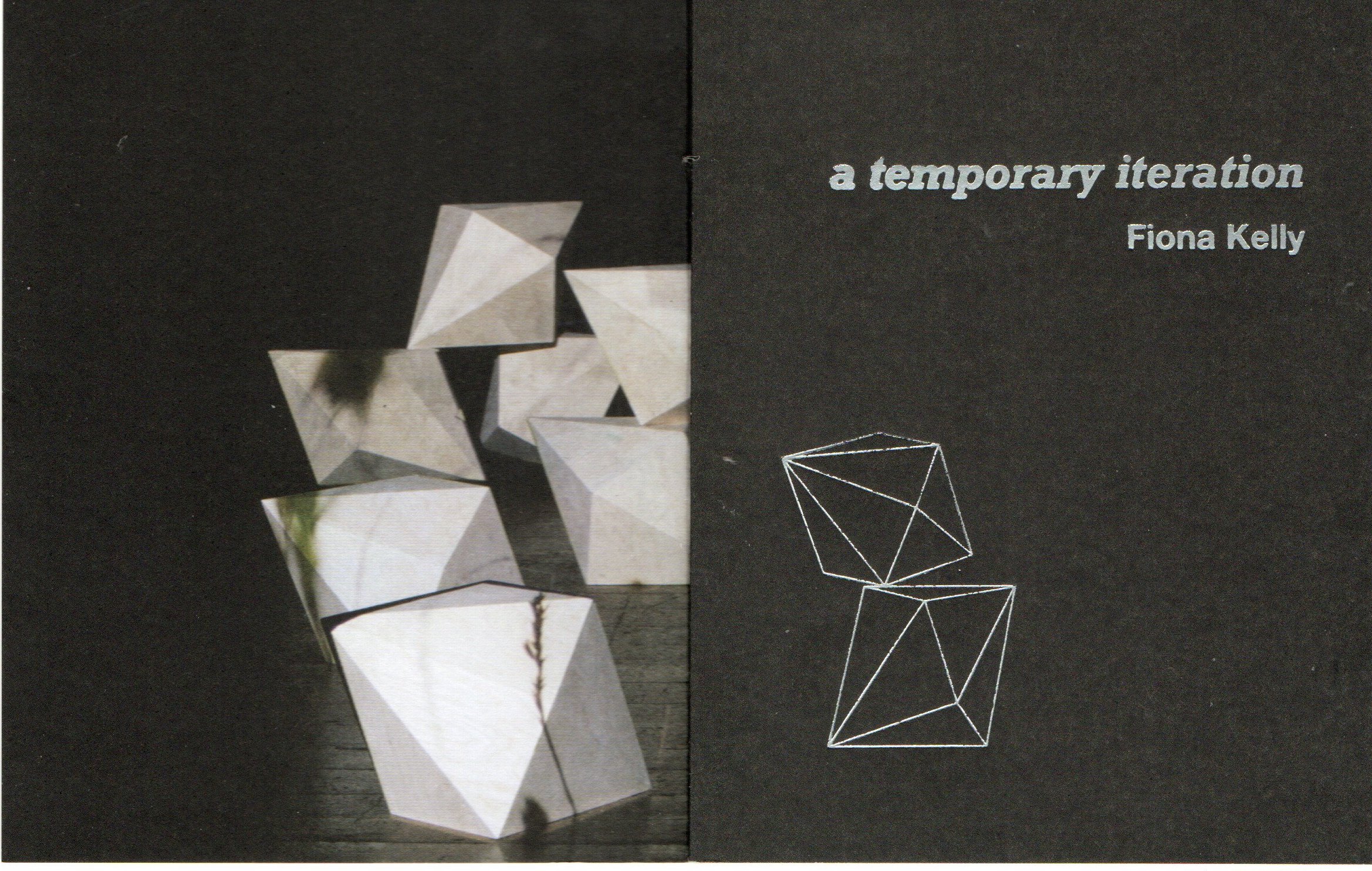
Fiona Kelly's new work A Temporary Iteration is an encounter with nineteen 3D pieces made from birch ply and other materials onto which a sequence of moving images is projected and a soundtrack interacts. These sculptures are enlarged scalenohedrons, a crystal formed from calcite, a mineral much of our world is made up of. It is also the primary element of the Esker Riada, the subject matter contained within the mapped projection, which appears and disappears on the sculptures' surfaces, each becoming a screen momentarily.
The Esker Riada is a system of eskers which stretches from Dublin to Galway, a natural halving of the island of Ireland. An esker is a long ridge which occurs when a glacier melts or partially retreats, leaving behind an edge. The Esker Riada has been a longstanding Irish site of quarrying and extraction.
Kelly engaged in a residency in Gannon Eco whilst producing this work. Gannon Eco, previously a quarry, is now a repurposing plant based on the Esker Riada in County Westmeath. The plant has been extensively rewilding parts of the old quarry and takes in large quantities of waste, such as glass, to create new ways for it to exist. Kelly has been collaborating with Gannon Eco since 2015, a longstanding relationship that has enabled her to utilise their materials in previous works.
The enlarged scalenohedrons take on many different forms as they slowly change. The viewer is met with landscapes, close-ups of grassland and flora, and then vast "slowscapes" of endless waste. The contrasting of images of nature, discarded materials, and ambient sound create an eery stillness.
Kelly’s imagined topography champions the earth beneath us. The idea of fallowness and stillness has been a continuous stream of exploration for her. This work highlights the matter and possibility created when we do nothing, continuously questioning what it is to be productive.
The work explores the Esker Riada, part of it located in what was previously a quarry and is now a space where extraction has ceased. We have learned that production creates new objects; however, these spaces are created when something stops.
Kelly continuously questions her activity as an artist, with art being a field producing objects in an already material-saturated world. If you are to make work which comments on s sustainability, is it possible to do so through object production?
The way in which Kelly has previously described her navigation of this dilemma or tension is by creating works that can exist in different iterations again and again. The enlarged scalenohedrons in themselves tessellate together to fit inside two small crates. They are easily transportable and can be put together effortlessly, even without the artist's presence.
Kelly references the idea of “solastalgia,” a theory advanced by Glenn Albrecht that “describes existential distress caused by climate change.” The Esker Riada is a space which has been extracted from since the eighteenth century, and quarrying is still happening today. Parts of it are protected habitats, but the landmass itself remains unprotected. This landmass, when left fallow, creates flora such as wild orchids.
Kelly does not describe the work as a call to action or a means to tell people what to do or think. Instead, she proposes a conversation around the Esker Riada, and more broadly land use, the possibilities of stopping, giving back and rewilding.
If we consider this work a means to dialogue, what are we left with to reflect upon? The play with scale through the enlarged scalenohedrons brings our scale, as humans, to mind, suggesting our presence within a much larger time scale and terrain. Our being is minute in relation to Earth, yet we have claimed so much of it through production, magnifying our existence on it. This work not only celebrates the earth beneath us in its most basic form, but also the possibility of fallowness, the end of measuring our production.
Kelly takes a careful and considered approach to sustainability, and touches upon it in many ways. Sustainability is a loaded word which surfaces a lot; however, much of its currency is shallow. On the other hand, sustainability is a topic that most of us consider daily, and we have learned that being sustainable is an action. This work presents an alternative, an undoing, the possibility in nothing, serving as a metaphor for a practice which truly and profoundly considers the environment, the work, the artist, the object, and the subject matter it engages with.
Text by Ali O’Shea Commissioned by the SIRIUS Arts Centre and Published on the Occasion of the Exhibition A Temporary Iteration 2022